
drone-laws-qld-a-simple-guide-for-real-estate-professionals

Feedback & RecreateAdd image manually
That stunning aerial shot of your latest listing could come with a hefty fine if you're not fully across Queensland's complex drone regulations. For busy real estate professionals, trying to decipher CASA's legal jargon is a time-consuming task, creating uncertainty around everything from privacy laws to operator licensing. The risk of accidentally breaking the rules-and facing significant penalties-can make using this powerful marketing tool feel more like a liability than an asset. Understanding the specific drone laws qld has in place is essential for protecting your business and your clients.
This simple guide is designed to provide clarity. We will break down the regulations into a straightforward, plain-English checklist, giving you the confidence that your property marketing is fully compliant. You will learn what is and isn't allowed, how to respect neighbour privacy, and why partnering with a licensed professional is the most reliable way to achieve quality results while avoiding legal issues. Let's ensure your aerial marketing is safe, legal, and highly effective.
Drone photography has revolutionised real estate marketing, providing breathtaking aerial perspectives that capture a property's full scale, location, and context. These compelling visuals can significantly increase buyer engagement and set your listings apart. However, launching a drone is not as simple as pointing and shooting; it involves navigating a complex legal framework designed to protect the public.
In Australia, the Civil Aviation Safety Authority (CASA) governs all aviation activities, and understanding the specific drone laws QLD agents must follow is crucial. The core purpose of these laws is twofold: ensuring public safety and respecting individual privacy. Failure to comply poses serious risks, including hefty fines, legal liability, and significant damage to your agency's brand.
Fundamentally, CASA classifies all drones as aircraft. This designation is critical because it means they are subject to strict airspace regulations designed to prevent catastrophic accidents with people on the ground, buildings, and other aircraft. The potential for serious incidents is real, and compliance is the only way to operate professionally and safely. This safety-first approach is a global standard, reflected in various International Drone Regulations that aim to integrate drones safely into national airspace.
Beyond aviation safety, drones present unique privacy challenges. While capturing stunning shots of a listing, a drone’s camera can easily film over fences into neighbouring backyards, pools, or windows, inadvertently capturing private moments. This is a significant concern under Queensland's privacy legislation. To operate professionally, it is essential to manage these concerns proactively. This includes planning flight paths to minimise intrusion and communicating with neighbours before a shoot to build trust and prevent complaints. Respecting privacy is a key pillar of the drone laws QLD and a hallmark of a reputable agent.
Ultimately, treating drone operations with the professionalism they require protects everyone. The risks of non-compliance are not just theoretical. Fines from CASA can reach thousands of dollars, and any incident involving injury or property damage could lead to severe legal and financial liability. More than that, a reputation for disregarding safety or privacy can cause irreparable harm to your personal brand and your agency's standing in the community.
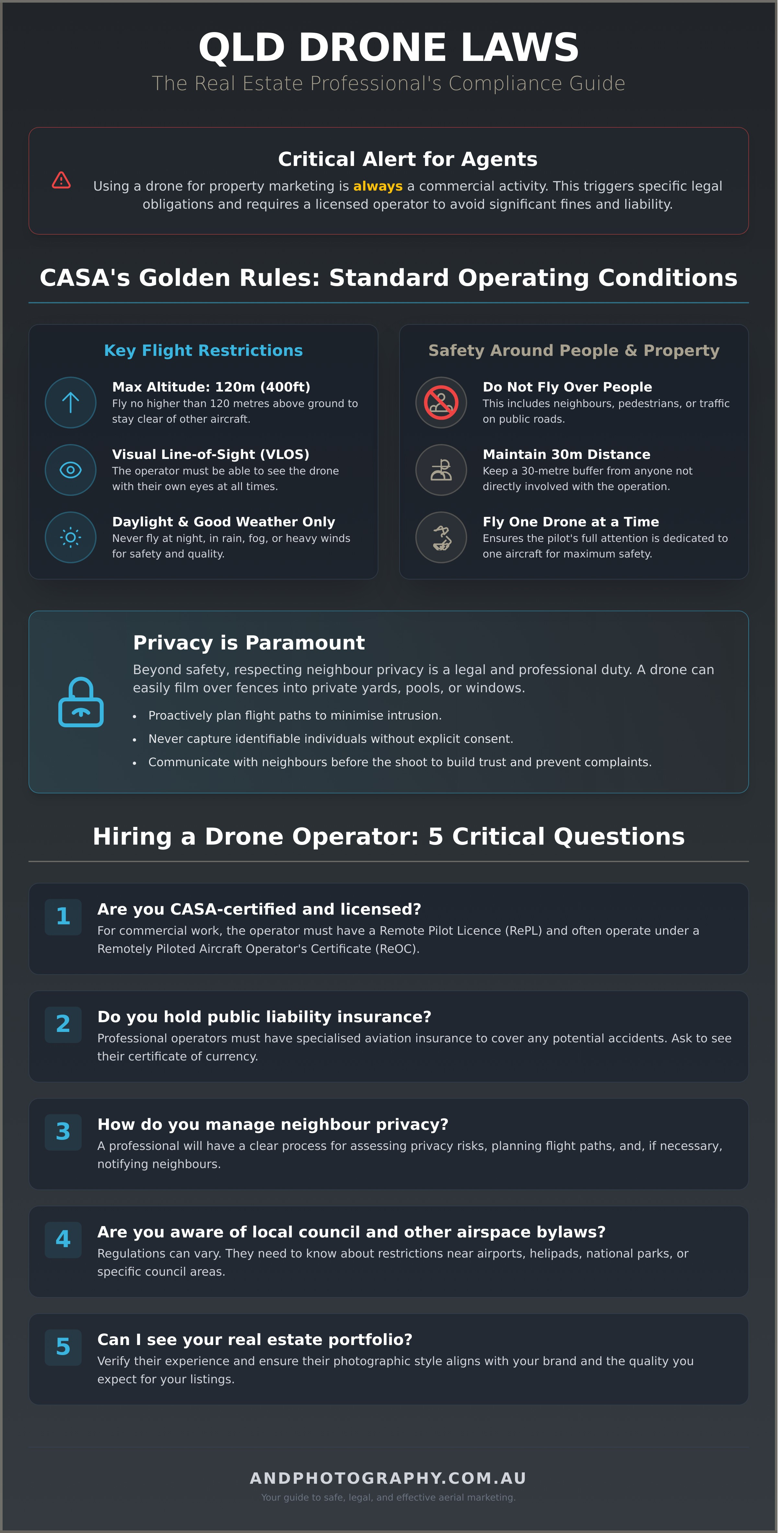
Before examining specific local council regulations, it's essential to understand the foundational rules that govern all drone flights across Australia. The Civil Aviation Safety Authority (CASA) sets these Standard Operating Conditions as the minimum safety requirement for every operator. Adhering to these federal regulations is the first step in ensuring any drone photography for your property listing is both legal and professional. While these are national standards, they form the core of the drone laws QLD agents must follow.
These core operational limits are designed to keep the drone within the operator's control and safely separated from other aircraft. For real estate purposes, these rules are straightforward to follow and still allow for capturing high-quality, impactful imagery.
Protecting the public is a primary focus of CASA's regulations. When commissioning drone photography for a listing, especially in populated suburban areas, these rules are critical.
Understanding where you can and cannot fly is a fundamental aspect of the drone laws QLD real estate professionals must respect. Certain areas are permanently or temporarily off-limits to ensure safety and security.
While the Civil Aviation Safety Authority (CASA) sets the foundation for drone operation across Australia, achieving full compliance in Queensland requires navigating an additional layer of state and local government rules. These regulations often pertain to land use, environmental protection, and specific local bylaws. Understanding these nuanced drone laws QLD is essential, particularly when marketing properties that border sensitive areas. A failure to comply can not only result in fines but also reflect poorly on your agency's professionalism.
Navigating this landscape demands local expertise. While all commercial operators must follow CASA's official drone rules as a baseline, a professional drone provider also understands the specific state and council-level requirements that apply to your listing.
Queensland has strict rules protecting its natural heritage. As a general rule, recreational drone use is prohibited in Queensland's national parks and state forests. For commercial purposes, such as capturing stunning aerials of a property bordering a park, a special permit from the Department of Environment and Science is typically required. A professional operator will manage this permit process, ensuring your marketing shots are both spectacular and fully compliant.
Individual councils have the authority to regulate drone activity on land they manage. Many councils, including Brisbane City Council, have bylaws that restrict or prohibit the take-off and landing of drones in public parks, reserves, and sports fields. This is a critical detail, as a nearby park may be the only viable launch site to capture the perfect angle of a property. A key part of a professional drone service is conducting this due diligence for you, verifying local laws to ensure every flight is legal.
Professional drone operation is about more than just avoiding buildings and people; it includes a duty of care for the environment. Queensland's regulations protect native wildlife from being disturbed, which is particularly relevant for coastal and rural properties with active bird populations. Furthermore, operators must be aware of any culturally sensitive areas or heritage sites. A trained and certified photographer is equipped to assess these environmental and cultural risks, ensuring your property is showcased responsibly.
One of the most critical misunderstandings surrounding drone laws QLD is the distinction between flying for fun and flying for business. The moment a drone is used to capture images or video for a property listing-even if no money changes hands-it is classified as a commercial operation by the Civil Aviation Safety Authority (CASA).
This single fact makes the common "my nephew can do it" approach not just unprofessional, but illegal. A recreational pilot is not licensed, insured, or trained for the complexities of commercial work. Engaging an uncertified operator exposes your agency, your vendor, and the pilot to significant fines and liability in the event of an accident or privacy breach.
For any commercial flight, there are two non-negotiable minimums. First, the drone itself must be registered with CASA. Second, the person flying the drone must hold a valid Operator Accreditation. This ensures the pilot understands the basic safety rules. Any photographer offering drone services without these fundamentals is operating illegally and putting your business at risk.
An Operator Accreditation is the bare minimum. A true professional will hold a Remote Pilot Licence (RePL). This qualification is earned through comprehensive training and examination, proving the pilot has a deep understanding of airspace regulations, risk management, and emergency procedures. A RePL is essential for more complex operations and allows the pilot to seek CASA approval to fly closer to people than standard rules permit-a frequent necessity in residential areas.
The gold standard for professional drone services is the RPA Operator's Certificate (ReOC). This certification is held by the business, not just the individual pilot. An ReOC demonstrates that the company has CASA-approved operational procedures, safety management systems, and internal training processes. It is the clearest indicator of a reliable, insured, and fully compliant drone provider. Our certified pilots ensure every shot is fully compliant.
Engaging a drone photographer is a powerful marketing decision, but it also introduces potential liabilities. To protect your agency, your clients, and your professional reputation, it’s essential to perform due diligence. Navigating the complexities of drone laws QLD requires a partnership with a qualified and professional operator. Use this checklist as a risk-management tool before any drone is launched for your property listing.
A reputable aerial photographer will not only have these answers ready but will welcome the opportunity to demonstrate their professionalism and commitment to safety.
These questions confirm the operator is legally permitted to fly for commercial purposes under Civil Aviation Safety Authority (CASA) regulations.
Beyond legal certification, a professional operator must demonstrate a robust approach to safety and risk mitigation on site.
Ensuring your chosen photographer can confidently answer these questions is the most effective way to guarantee a high-quality, safe, and legally compliant result for your property marketing. At AND Photography, we provide complete documentation and adhere to the highest standards of safety and professionalism for every flight.
Navigating the regulations for aerial photography is essential for protecting your agency, your clients, and your professional reputation. The distinction between commercial and recreational use is critical, and for real estate, all drone work falls under commercial rules. Understanding the specific drone laws QLD is not just about avoiding fines-it is a non-negotiable part of modern real estate marketing that safeguards your business.
The most effective way to guarantee compliance and achieve stunning visuals is to partner with a proven expert. At AND Photography, we remove the legal complexity from your workflow. Our operators are fully CASA-certified and licensed and backed by comprehensive public liability insurance for your complete peace of mind. With extensive experience in the Brisbane and Queensland real estate market, we deliver professional, reliable service you can trust.
See the difference that a professional, results-oriented approach makes. View our professional drone photography portfolio to see how we help leading agencies elevate their listings.
Fines for breaching CASA regulations can be substantial. For individuals, on-the-spot penalties for many offences can be up to A$1,378. For more serious breaches, such as operating a drone in a way that endangers people or property, courts can impose much larger fines that may exceed A$13,000. Partnering with a professional, fully licensed drone operator is the most reliable way to mitigate these financial and legal risks and ensure all operations are compliant.
While there is no specific legal requirement under CASA rules to inform neighbours, it is considered professional best practice and is highly recommended. Providing courteous notification helps prevent privacy complaints, which are covered by separate Queensland legislation. A professional drone photography service will typically manage this communication, ensuring a smooth and considerate process that reflects positively on your agency and the seller, preventing potential disputes before they arise.
No, even when flying over the seller's property, all standard CASA safety rules apply. The drone must always be kept within the operator's visual line-of-sight, fly no higher than 120 metres (400 feet) above ground level, and stay at least 30 metres away from people not involved in the operation. These national regulations are in place to ensure public safety, regardless of who owns the land directly below the drone.
The fundamental safety regulations established by CASA are consistent across Australia, applying equally to regional and metropolitan Queensland. The main difference is the prevalence of restricted airspace. Cities like Brisbane have more no-fly zones due to major airports, helipads, and higher population density. While regional areas may have fewer restrictions, it is essential to check official airspace maps before every flight, as local aerodromes and other sensitive sites still create no-fly zones.
The most reliable method is to use a CASA-verified drone safety app, such as 'OpenSky'. These applications provide up-to-date digital maps that clearly illustrate restricted airspace and no-fly zones. Key areas to be aware of include the 5.5km radius around controlled aerodromes, helipads, and sensitive locations like prisons or national parks. A professional drone service provider will always conduct this essential pre-flight check as a standard part of their workflow.
Using homeowner footage for a commercial purpose like a property listing is not recommended. To comply with Australian drone laws QLD agents must follow, a person flying for business must typically hold a Remote Pilot Licence (RePL) and operate under a Remotely Piloted Aircraft Operator's Certificate (ReOC). Using unlicensed footage can expose your agency to significant liability risks and often results in lower-quality imagery that fails to meet professional marketing standards for your listing.